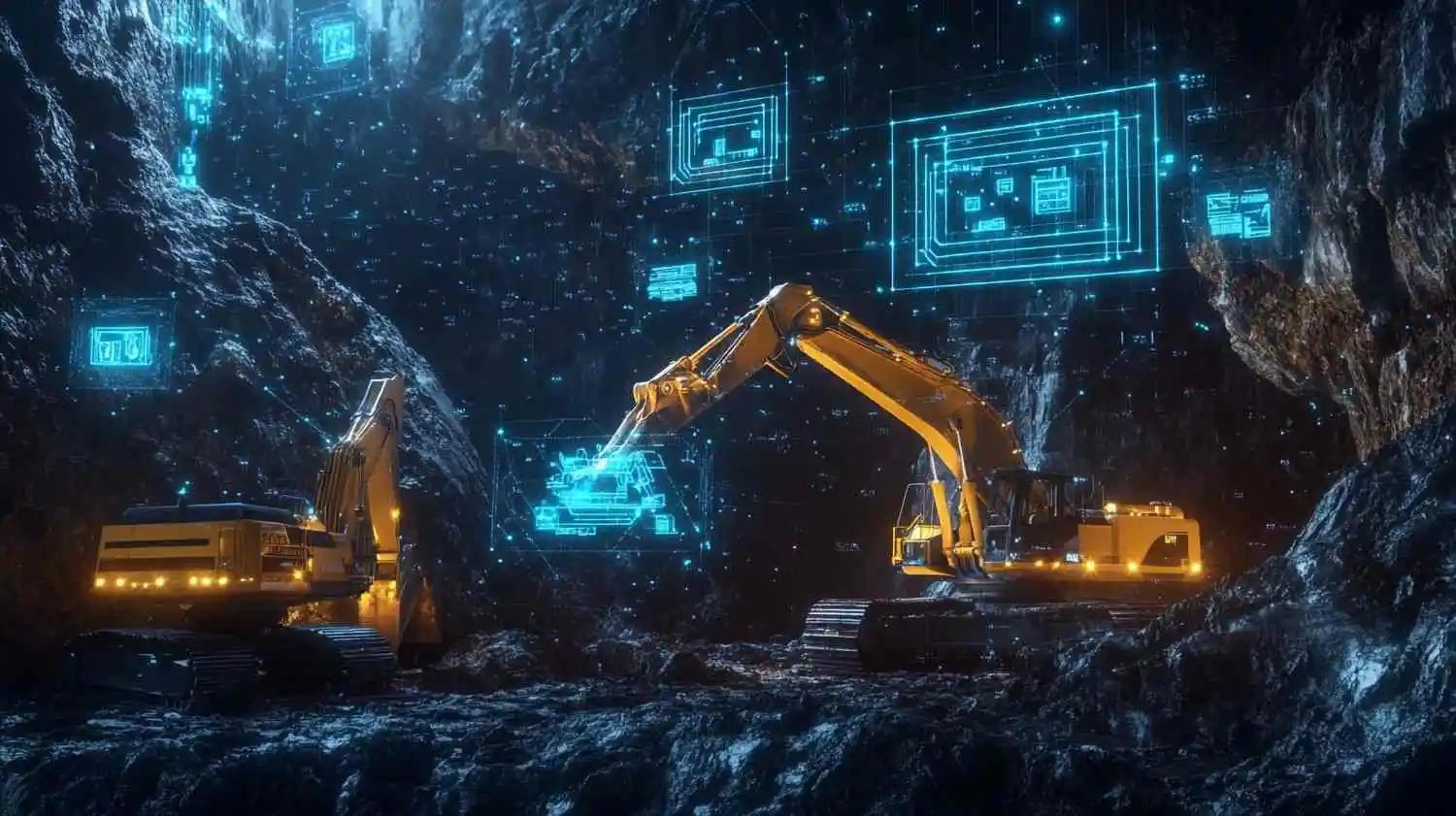


Today’s most advanced mines haven’t looked like mines from ten years ago. Sensors on haul trucks, mills, and flotation cells feed data into models that recommend changes before a shift supervisor notices a problem. That is smart mining technology in practice: connected mining operations turning scattered signals into real-time decisions instead of end-of-shift reports that arrive too late to act on.
What Makes a Mine Smart
Intelligent mining systems link three layers that traditionally sat apart: geology and stockpile data, fleet and material movement, and plant processing instrumentation. When these layers talk to each other, planners get dynamic grade, hardness, and bendability insights as material actually flows, rather than static estimates from a block model that go stale until the moment ore is extracted.
Core Capabilities of Smart Mining Solutions
AI in mining today typically covers several connected capabilities that work together rather than as standalone tools:
- Real-time stockpile modelling and blend optimization
- Soft sensors that improve grind-size precision and stability
- Machine learning models that recommend flotation adjustments as conditions shift
- Mining automation technology that adapts targets while keeping plant controls stable
NTWIST's MineMax platform is built around this set of capabilities, connecting stockpile, fleet, and plant data without displacing systems already in place.
The Results Connected Operations Are Seeing
Digital mining that connects these layers has produced measurable plant-level gains: a 20% increase in grind target compliance, recovery gains of up to 12%, and up to $250,000 a year saved at a single nickel concentrator through better feed predictability. On some sites, soft sensors have delivered as much as 1.6% additional recovery and 30% reagent savings on the same plant and feed, without new capital equipment, which is the kind of gain that used to require a full plant upgrade.
One circuit control model increased potential profit in 42% of operating hours and corrected off-target conditions in another 17%, results built from continuously nudging operations toward target rather than waiting for a monthly review.
Smart Mining in the Field
A leading gold producer partnered with a global technology company to deploy NTWIST's MineMax platform for real-time ore optimization at the edge, reducing waste and improving recovery while enabling faster on-site decisions without relying on a central data center.
A separate gold producer moving to full stockpile reliance used GPS-based modeling to validate its stockpile estimates independently during a high-risk transition, giving its team confidence that feed decisions would hold up once open-pit mining ended.
Why This Matters Now
Across the industry, an estimated 15% of operations still work in a surprise zone, with no reliable insight and high variability, and more than 80% of production decisions are made on intuition rather than real-time data. Smart mining technology exists to close that gap without requiring operations to abandon the block modeling, historian, and control systems already in place.
For most sites, the cost of staying in the surprise zone shows quietly in missed recovery and inconsistent throughput, rather than a single visible event.
Getting Started
Operations considering intelligent mining systems typically start by identifying where variability costs the most, whether in feed quality, grind performance, or flotation recovery, then layering in real-time monitoring before automation.
Connected mining operations succeed when teams trust the data before they trust the recommendations built on top of it, which is why most MineMax rollouts expand gradually from one circuit or site to the next rather than launching everywhere at once.
Frequently Asked Questions About Smart Mining Technology
Q1. What is smart mining technology?
It connects geology, fleet, and plant data into one real-time system, so teams act on variability as it happens instead of after a shift or a monthly review. That shift from periodic reporting to continuous signal is what defines a connected mine.
Q2. How is AI in mining different from traditional automation?
Traditional automation follows fixed rules. AI in mining continuously adjusts recommendations, such as flotation dosing or grind targets, based on live conditions.
Q3. Do connected mining operations require new equipment?
Not necessarily. Platforms such as NTWIST's MineMax layer soft sensors and models on top of existing plant equipment and control systems.
Q4. What results have been achieved by connected mining operations?
Reported results include up to 20% improvement in grind target compliance, up to 12% recovery gains, and up to 30% reagent savings on the same plant and feed, achieved without new capital equipment in most of the sites reporting these numbers.
Q5. How long does it take to implement mining automation technology?
Most operations reach measurable clarity within 90 days, with initial payback often achieved in under 45 days of production use.