

In a high-mix plant, the morning schedule tends to hold up until the first changeover runs over. That schedule came out of the ERP. It assumed the routing times were right, that every setup takes the same flat allowance, and that each part on the bill of materials would be at the line when the work order started. A plant running a few SKUs on dedicated lines can get by on that. A job shop or contract manufacturer with hundreds of part numbers can't, and by mid-morning the dispatch list on the floor and the plan in the office look like they belong to two different factories.
We've studied this gap in high-mix, low-volume operations. Setups and changeovers take up 15% to 30% of production time. Only 45% to 55% of operator hours turn into productive work. In 60% to 70% of these plants, sequence-dependent changeovers keep coming up as a problem. None of that is about slow machines. It's a plan that doesn't fit the shift it was written for. That mismatch is where we think AI in manufacturing earns its keep in 2026, even though scheduling gets a fraction of the attention robotics and generative AI do.
Where AI Is Being Applied in Manufacturing
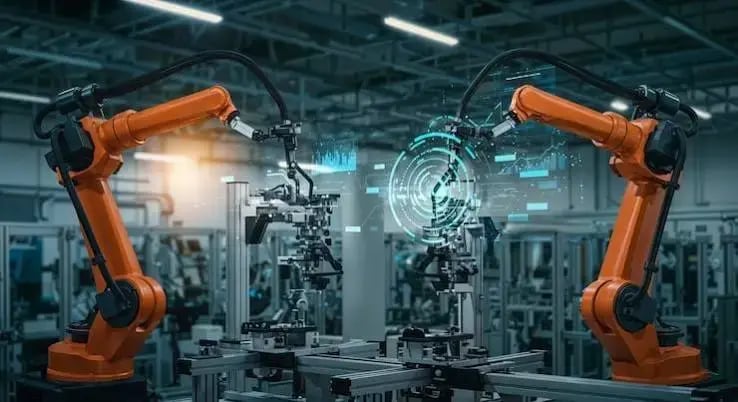
Most of the artificial intelligence in manufacturing right now doesn't run anything by itself. It sits beside a handful of decisions plants make every shift, and each of those decisions usually has its own data and its own owner.
Maintenance tends to come up first. Sensors on a motor pick up vibration and current, and the model learns what normal looks like for that particular machine. When a bearing or spindle begins to wear, the readings drift, and maintenance gets enough warning to book the job into planned downtime instead of losing a run to it. Vision inspection does something similar on the quality side. Cameras check welds and labels at line speed and every image is saved, which means a defect that keeps showing up can usually be tied back to a particular press, mold cavity or batch of material.
Planning teams use it too. Forecasting models combine order history with seasonality and what customers are signaling, and inventory models work out reorder points from how fast each part is consumed. For a lot of plants that replaces a min-max table nobody has updated in years. Cobots with vision can now pick parts out of bins and learn a new SKU from a few examples. That used to take a full reprogramming cycle. Generative AI, meanwhile, has mostly ended up in documentation. Summarizing shift logs is a common use, and so is digging the one useful paragraph out of a 400-page equipment manual.
Scheduling runs through all of it. A maintenance alert only helps if the production plan can react to it. The same goes for a late supplier or a failed first-article inspection. That's why more plants are starting to treat AI as a decision layer above the ERP and MES, rather than a pile of point tools each firing off its own alerts.
Choosing Where to Apply AI First
Almost every plant has more AI ideas than budget or engineering hours. The ones we see pay back usually have four things in common.
The first is that the loss is already being measured. A plant that tracks OTIF, overtime and changeover duration today can show movement within weeks. A plant that still has to agree on a baseline tends to spend its first months arguing about the numbers.
Frequency matters too. Sequencing calls happen dozens of times a day on every line, so small gains add up fast.
Then there's the data. Work orders, routings and shift calendars almost always exist in some usable form. Vision inspection is a different story. It can need new cameras, proper lighting and a library of labeled defect images before anyone trusts it.
Ownership is the last one, and it's often the one that decides things. Without a named owner in operations, a use case stays a pilot, however good the model looks in testing.
Run scheduling and material coordination through that filter and they meet all four. That's why most high-mix plants start there.
Why Plans Break Between the ERP and the Shop Floor
An ERP does a good job as the record of demand, routings and inventory. It was never built to sequence work against the constraints a shop floor really has. Most plants fill that gap with a spreadsheet that one or two planners keep alive, and by our estimate 50% to 70% of manufacturers still plan production this way.
Three assumptions built into that plan cause most of the trouble. One is that changeover time is a fixed number. In reality it depends on whatever ran before. Two similar parts back to back might need a fraction of the standard allowance, but switch material, color or tooling and the same machine can take several times as long.
Another is that any operator can run any job, when certain setups need someone with a specific skill or certification. The last one is that materials will be there at release. Sometimes they're still in receiving, or they've already been promised to a different order. A high-mix shop runs into each of these often enough that, a few hours into the shift, the schedule no longer reflects what's happening on the floor.
Operations managers see the effects every week. Supervisors stop following the schedule and go by their own experience. Planners end up rebuilding the plan two or three times a week. OTIF levels off somewhere between 70% and 80%. Overtime goes up to make back lost hours, while machines stand idle waiting for a setup crew or a missing part.
The spreadsheet also depends heavily on the person who maintains it. If that planner goes on leave, many plants fall back on first-in, first-out sequencing, and the damage isn't obvious at first. It turns up a week or two later as late orders.
What Constraint-Aware Scheduling Changes
Constraint-aware scheduling takes in the limits that standard-time planning leaves out, including machine capability, sequence-dependent changeovers, operator skills, shift calendars, tooling and material readiness. It weighs them together and looks for a sequence that works within all of them without putting due dates at risk.
Compared with even a good spreadsheet, two things are different. The system learns standard times and changeover durations from production history, so its estimates keep improving as more data comes in. It also republishes the schedule on its own when conditions change. If a machine goes down or a rush order comes in, a revised plan is ready within minutes, where before someone would have spent most of a day redoing cells by hand.
Planners don't disappear in this setup. Their job moves from building sequences by hand to setting priorities and sorting out the conflicts a model shouldn't settle alone, like two customer orders fighting over one machine.
This is the problem we built Nexus iMES to solve. It links ERP work orders to execution on the shop floor, models the plant's constraints and closes the loop with updates from operators. Once the constraint model and the execution loop are both running, deployments have recorded throughput gains of 5% to 30%, OTIF above 95% and cycle time reductions of 20% to 30%.
For plants that move off spreadsheet planning more broadly, the numbers point the same way. Lead times typically drop 15% to 30%. OTIF climbs from a 70% to 80% baseline toward 93%. Planners spend 25% to 35% less time on manual replanning, and work in process usually falls by 10% to 25%.
Materials, Maintenance and Quality as Scheduling Problems
 Three of the use cases from earlier look like separate projects on paper. In practice, each one needs the schedule before its signal turns into a result.
Material Readiness
Shortages usually get logged as a purchasing problem. A lot of them are really timing problems, caused by a schedule with no idea which components are physically in the building. We estimate kitting and material readiness issues affect 45% to 70% of plants. Once the schedule and the material plan work off the same data, a shortage shows up before the job is released, not after the line has been set up for it. Plants using our manufacturing solutions have reported up to 25% fewer material shortages this way.
Maintenance and Disruption Response
Predictive maintenance programs that stick usually start small, on one bottleneck asset whose failure stops everything, often a press, an oven or a machining center. Downtime on that one machine costs enough to pay for the sensors, and it gives the team a contained place to learn.
Alert volume has to be managed from day one. A model that throws off a stream of low-confidence warnings gets tuned out within weeks. Thresholds need to be set with the maintenance team and checked against the failures that actually happen.
Even a good model can only tell you an asset is likely to fail. What that warning is worth depends on what the schedule can do with it. If the scheduler can move work to alternate resources on its own, one stoppage doesn't snowball into a week of late orders. NTWIST deployments have recorded disruption response up to 40% faster than manual replanning.
Quality and Root Cause
Vision systems are good at spotting defects. Explaining them is harder, and that takes context.
Once inspection results are tied to the production sequence, a quality engineer might notice that defects spike whenever one product follows a particular changeover on one line. Then the fix could be a change to the sequencing rules rather than another inspection station at the end of the line.
It helps to be realistic going in. Lighting and camera placement both affect accuracy, and so does normal variation in how a part looks. A model trained on too few real defect examples will either miss defects or reject good parts. Before the system goes live, quality and production should agree on how many escaped defects and false rejects they can live with.
The Data a Plant Needs to Start
Worry about data quality holds up more projects than bad data does. Scheduling can usually start with four sets of records.
- Open work orders and due dates from the ERP
- Routings and machine capabilities
- Shift calendars and operator skills
- Inventory and material availability
The master data will have gaps. Routings go stale. Standard times go missing, and some machines end up assigned to the wrong capability. A good platform shows those gaps instead of hiding them.
Nexus iMES runs validation checks that flag missing operations, mismatched statuses and broken relationships before they hit the schedule, and where records are thin it learns standard times from production history.
Replacing systems is rarely practical. Most plants run an ERP that's been around for years, a newer MES and a scattering of spreadsheets. Connecting them through APIs, scheduled exports or direct database links avoids a rip-and-replace.
Every connection still has to meet the plant's security requirements. That means role-based access, encryption in transit and at rest, audit logging, and a choice of cloud, hybrid or on-premises deployment.
Sequencing a First Deployment
A good first project goes after a problem the plant already measures, whether that's late orders, persistent overtime, long changeovers or recurring shortages. One line or one product family is plenty for a pilot. What matters is recording the baseline before anything changes.
With Nexus iMES the usual path has three stages. If minimum viable data is available, a trusted scheduling loop goes live within 30 days. An execution loop with operator updates follows by week eight, and expansion to more lines or sites comes by week twelve.
Our deployments typically reach positive ROI within 45 days of go-live and recover more than $2 million in annualized value each. Across all of NTWIST's manufacturing deployments, that adds up to more than $17 million in annualized value so far.
One discrete manufacturer shows how this plays out. Once constraint-aware scheduling was in place, the plant gained 29%+ more capacity from the equipment it already had.
Trade-offs Worth Planning For
AI scheduling won't cover for poor master data forever. Learned standard times buy some slack, but someone still has to keep routings and machine capabilities current.
Getting people to use it is usually harder than getting it to work. Supervisors with years on the floor want proof before they follow a schedule a system came up with. Running in advisory mode first, where the system recommends and people make the call, lets that proof build without putting production at risk.
Automating too much has its own cost. Deciding which customer gets priority, or whether to accept a quality deviation, comes down to commercial judgment. A model can inform that call. It shouldn't make it. Agree up front which decisions the system can execute and which need someone's sign-off.
AI can't create capacity a plant doesn't have. If one machine really is the limit, better sequencing will make that obvious, which is worth knowing. The answer may still be a capital investment.
AI in Manufacturing Trends for 2026 and Beyond
Agentic AI is starting to connect steps that now pass through several people's hands. An agent could spot a late supplier shipment, check for alternate stock and have a resequenced schedule waiting for the planner's approval before the morning production meeting.
Digital twins are also moving beyond engineering use. Fed with live plant data, a twin lets planners try out next week's schedule before it gets to the floor.
For more insights into the role of AI and machine learning in smart manufacturing, explore the 2026 NIST roadmap on artificial intelligence and machine learning for smart manufacturing.
The catch is that a twin only works as well as the constraint data behind it. It still needs the same changeover, labor and material records a scheduling project depends on.
Fully lights-out plants will probably remain rare. A more likely picture is a plant where routine scheduling, inspection and maintenance decisions are made automatically, and the people there spend more of their time on exceptions, improving the process and meeting customer commitments.
For plants where the schedule rarely makes it through a shift, the most useful first step is usually a pilot on one line with a clear baseline. Nexus iMES was built for that kind of start and works with the ERP and MES data a plant already has.
Book a Demo Call with the NTWIST team to see how it would apply to your operation.
Frequently Asked Questions About AI in Manufacturing
1. What is AI in manufacturing?
AI in manufacturing refers to software that learns from machine data, work orders, quality records and material information, and uses that to predict outcomes and suggest actions on the production floor. Most plants run it alongside their existing ERP and MES rather than replacing either one.
2. How is AI used in manufacturing?
Common uses include predictive maintenance, computer vision inspection, demand forecasting, inventory optimization, vision-guided robotics and constraint-aware production scheduling. Scheduling is often the first to pay back in high-mix plants, since it brings the signals from the other areas into a single plan.
3. What are the benefits of AI in manufacturing?
It depends on the use case. For production scheduling, Nexus iMES deployments have recorded throughput gains of 5% to 30%, OTIF above 95% and cycle time reductions of 20% to 30%. Plants that move off spreadsheet planning also report 25% to 35% less planner time spent on manual replanning.
4. What are the challenges of AI in manufacturing?
The big ones are incomplete master data, integration with legacy systems, cybersecurity and winning over supervisors and planners. Starting with a pilot in advisory mode lowers each of these risks before the system is allowed to act on its own.
5. What is the future of AI in manufacturing?
Expect agents that handle multi-step planning tasks with human approval, and live digital twins used to test schedules before release. Plants will automate more routine decisions while people deal with the exceptions.
About the Author
Pramodh Chandrashekar is an industry and technology expert and Senior Researcher at NTWIST. His expertise includes industrial AI, mining and manufacturing technology, digital transformation, and operational optimization.
He focuses on applying AI and data-driven technologies to improve operational efficiency and business performance.
LinkedIn: Pramodh Chandrashekar