%20(19).jpg?width=1200&height=630&name=Featured%20Images%20(1200%20x%20630%20px)%20(19).jpg)


Forecasting production is a fundamental aspect of mine planning. Wrong forecasts create a chain of erroneous results, affecting everything from geology to finance. Today, AI production forecasting in mining is moving operations from reactive guesswork to dynamic, real-time decision making. Unfortunately, many traditional forecasting models use a lot of assumptions, resulting in overcommitment, underperformance, and bad equipment utilization. AI adds new possibilities of precision and adaptability to forecasting, turning a static model into a decision-making engine that is constantly improving.
The Challenges of Traditional Forecasting
Many issues make mining forecasting a challenge. Here are some of the setbacks:
- Static Models: Most mining forecasting tools use historical data, averages, or conservative estimates. This means they are not responsive to the current situation in the field.
- Slow Update Cycles: Most teams in mining forecasting create a new forecast each month/quarter and as a result, they are falling behind the volatility of production.
- Siloed Data: Planning, operations, and geology have separate and fragmented data systems. This results in inaccurate forecasts. (GMG, 2024).
- Continuous model updating: Algorithms learn new production data and customize forecasts (Mathworks, 2023).
- Multivariable analysis: AI focuses on the integration of models wherever possible (geological model, mill and haulage performance, and weather forecasts).
- Scenario planning: Involves using real time data to adjust production expectations to account for changes in material flow, machine availability, or price fluctuations (Hyndman & Athanasopoulos, 2023).
- Increased Accuracy: Forecast errors will be significantly lower when real data is used rather than predicted or assumed behavior.
- Increased Speed: The goalpost will no longer be a static forecast; timeframes will be adjusted as the new information becomes available.
- Improved Alignment: AI will make forecasting real-time and accessible to all planning and operational finance, improving forecast accuracy.
All of these become very expensive systems and cause friction among teams. Hence, the mining industry is optimizing forecast production AI.
AI and Production Forecasting
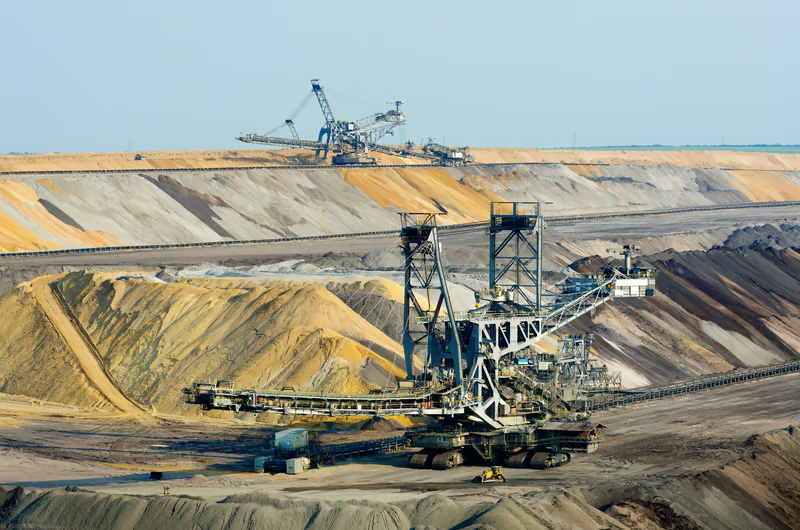
AI-based forecasting systems use machine learning and simulations to create quicker and more accurate forecasts with continual data. Here is how:
We create tools for production forecasting using machine learning to incorporate data at the highest available frequency. The method mitigates the unexpected and encourages daily production to meet long-term planning modular expectations.
AI-Based Forecasting Advantages
With AI transforming forecasting from being reactive to predictive, mining operations become both faster and more intelligent.
Conclusion
In mining forecasting, production forecasting tools will only ever be as good as the available data set and the logical planning governing that data. AI Processing in operations will go beyond static, spreadsheet-based forecasts. Mining operations will be better situated to keep up with greater foresight, agility, and real-world responsiveness, as opposed to a quarterly reconciliation model.
People Also Ask
1. What is AI production forecasting in mining?
AI production forecasting in mining is the use of machine learning algorithms to predict material output, performance, and flow efficiency, in real time. These predictions provide an advanced supplement to traditional static forecasting models.
2. How does AI improve forecast accuracy in mining operations?
AI integrates models and operational systems with real-time production data, aided by external and internal factors, thus significantly reducing forecast errors and adjusting forecast models with the same agility.
3. What challenges do classic mining forecasting techniques have?
Classic mining forecasting techniques have challenges such as depending on historical averages for predictions, infrequent updates (often monthly or quarterly), isolation among different planning, operational, and geological data systems, to name a few, all of which are a drag on accuracy and decision-making.
4. Which mining teams do you find have the most to gain from an AI-based approach to forecasting?
AI forecasting provides value to the mining teams planning, metallurgy, operations, and finance. With an AI-based approach, a unified forecasting layer is created that is accessible to all planning teams and eliminates the deviations and delays that were traditionally caused by the reliance on the monthly or quarterly updates of a forecast.
5. Will an AI-based forecasting solution work with the mine planning tools that are already in the market?
Absolutely. AI-based solutions, such as NTWIST, are designed to work in conjunction with mine planning and dispatch systems, as well as enterprise resource planning and geological modeling systems, without requiring a complete overhaul of existing mine systems.
References
GMG. (2024). Foundations of AI: A Framework for AI in Mining. Global Mining Guidelines Group. Retrieved from https://gmggroup.org/.../Framework-for-AI-in-Mining...
Hyndman, R. J., & Athanasopoulos, G. (2023). Forecast Reconciliation: A Review. International Journal of Forecasting. Retrieved from https://www.sciencedirect.com/science/article/pii/S0169207023001097
MathWorks. (2023). Production Forecasting from Pit to Port Using Simulation. Retrieved from https://www.mathworks.com/.../production-forecasting-pit-to-port-whitepaper.pdf