
Mine-to-Mill 2.0 Webinar
Watch the latest recording to learn how AI + digital twins optimize mining throughput from pit to plant.
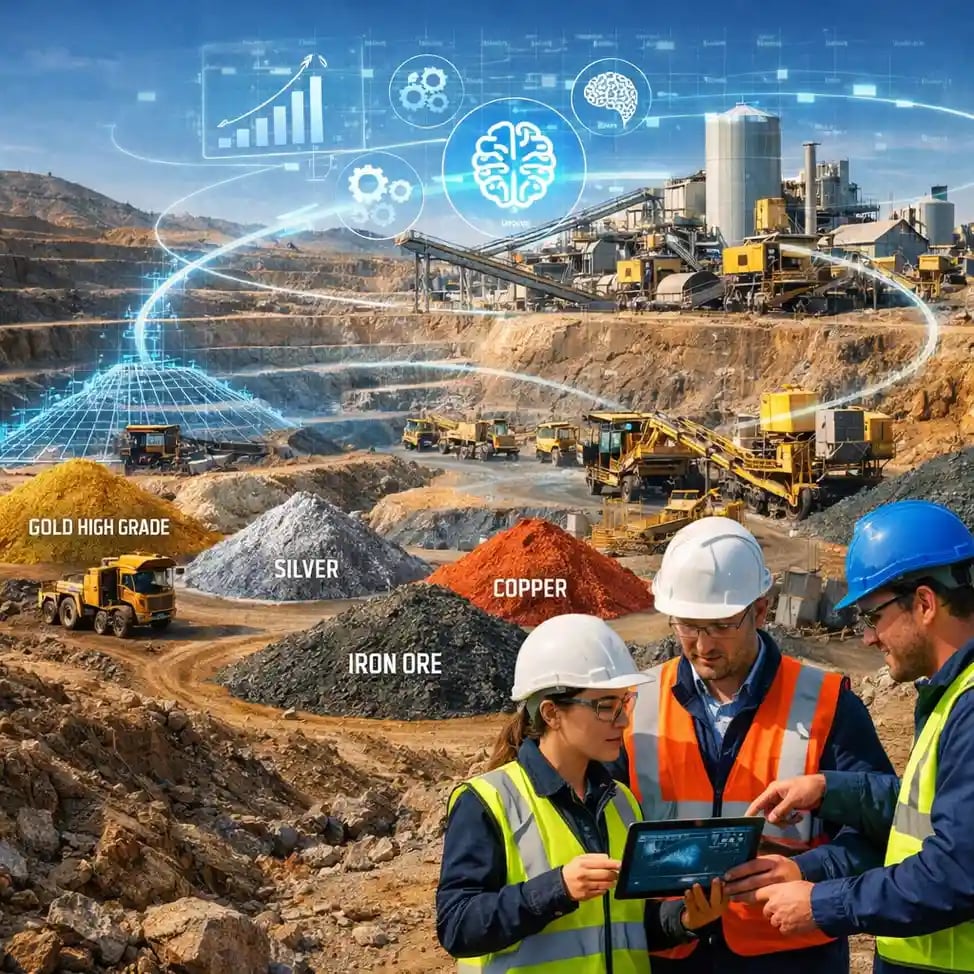

For decades, the promise of “Mine-to-Mill” optimization has been clear: integrate the entire value chain from the geology of the pit to the final product to maximize throughput and recovery. However, in the case of most operations, this is not being delivered. Conventional Mine-to-Mill 1.0 programs usually terminate optimization at blast-to-grind with substantial emphasis on fragmentation and energy efficiency with significant lapses in stockpile management and predictability of plant feed.
The outcome is an isolated value chain in which geology, mine planning, and metallurgy work independently. Each transfer of information is lost at the pit, at the truck, to the stockpile, and ultimately to the plant. Such infidelity makes variability a more uncontrollable risk that causes reactive control of plants, loss of recovery, and excessive operational expenses.
The industry is currently shifting to Mine-to-Mill 2.0. This new paradigm is not merely a disaggregation model but an integrated and evidence-based approach where geology, planning, and operations are all linked. Furthermore, operations can now predict, manage, and use variability as an advantage that is controlled by using advanced AI and digital twin technology.
The inherent problem with contemporary mining is not merely falling grades but the fact that variability is difficult to observe and control as a material travels down the value chain.
In the normal operation, there is a high-resolution block model in the mine planning software. But when that ore is blown up and pushed into a truck, the valuable information that comes with it is usually leveled down into a polygon-averaged grade. And when this material is dumped by the truck on a stockpile, it is again aggregated into a rough average.
Based on these rough averages, grades, and other ore properties, reclamation planners do their work. And when finally the material is reclaimed and brought to the processing plant, the operators are operating blind. Their feed is a black box, and they are operating on crude averages that conceal vital changes in grade, hardness, and mineralogy.
The loss of this information produces a wave of inefficiency:
In conditions where variability is not controlled, the plant gets the cost in three ways:
The financial impact is significant. In the case of a mid-level gold producer, uncontrolled variability may also cost damages in millions in terms of lost revenue and waste of reagents annually.
Mine-to-Mill 2.0 bridges this gap by establishing a digital flow between the resource model and the plant control system. It has three pillars: Track, Plan, and Optimize.
The MineMax suite by NTWIST reflects this 2.0 framework, providing certain modules that will cover each step of the value chain.
OreMax converts black box inventory into high-confidence assets. It provides full auditability of material between the pit and long-term stockpiles and the block models. It substitutes averages with stockpile resources, enabling geologists to measure the quantity of stockpile resources, and gives ammunition to the planners of how to transform stockpile resources into reserves.
DynaMax gives a real-time display of the ROM pad. It substitutes finger averages with block-level accuracy and records the ore properties as they rest or move on the pad. This can be used to forecast the short-term feed accurately so that the planners are aware of the material that will be fed to the plant.
PlanMax builds the best blending strategies using the inventory data of OreMax and DynaMax. It coordinates extraction operations with the capacity of the plant so as to maintain a steady feed that can be used to achieve production goals at reduced downstream variability.
MillMax performs the ultimate feedback loop. It involves predictive geometallurgical models and soft sensors that predetermine the future behavior of the present feed in the plant. It then offers setpoint prescriptive guidelines as to reagent dosage, air rates, or pump speeds to maximize recovery and throughput dynamically.
The transition to Mine-to-Mill 2.0 is already bringing quantifiable value to a number of commodities.
In a gold operation of 100 koz/year, DynaMax integration with MillMax gave real-time insight into the variation of feed. The system forecasted the effect of feed modifications on the recovery and suggested the best SIBX (collector) dosages.
At an open-pit gold mine in Brazil, ramp-up pressures caused common routing errors in which high-grade ore was directed to waste. NTWIST introduced a tracking system that was used to visualize these errors.
A gold-copper mine that was ready to switch to stockpile-only operations. It was important to carry out correct reserve estimation. NTWIST implemented a probabilistic map, which allocated grade and confidence to every block in the stockpiles. Result: The model confirmed the site estimate to be accurate at a high level (copper within -1.7% and gold within +0.7%) and gave a confidence map, which enabled risk-conscious planning and blending.
The digital transformation overhaul in Mine-to-Mill 2.0 does not take multiple years to implement. NTWIST deploys a 90-day blueprint to achieve quick wins:
This quick deployment enables the launching of operations that create value, which includes a higher feed predictability and fewer misplacements, within a quarter.
The mining sector can no longer afford to lose precious information between the mines and the mill. Mine-to-Mill 2.0 is a needed development of the operational strategy, transforming the problem of ore variability into a predictable cash flow.
NTWIST allows operations to see the invisible, forecast the future, and maximize all the tons coming into the plant by linking geology, planning, and processing together through an integrated, AI-based system of reality.
Ready to unlock hidden value?
Discover how much value is hiding in your stockpiles and process data. Book a complimentary assessment with NTWIST today to analyze your current performance and identify immediate opportunities for optimization.
Get Your Free Stockpile Assessment
What is Mine-to-Mill optimization in mining?
Mine-to-Mill optimization is a mining approach in which the mine planning, blasting, stockpile management, and mineral processing are combined to enhance the recovery and throughput of metals throughout the whole mining value chain.
How does Mine-to-Mill 2.0 improve mining operations?
Mine-to-Mill 2.0 is an AI-based digital twin platform using geometallurgical models to trace the ore characteristics from the pit to the processing plant. This allows predictive blending, enhanced control of the plant, and lower variability of operations.
Why is ore variability a major challenge in mining?
Ore variability influences the feed grade, hardness, and mineral composition. This variability can decrease recovery, decrease the throughput of the plants, and increase the cost of reagents and energy without proper tracking and predictive models.
How do digital twins help optimize mining processes?
Digital twins will build a virtual model of mining activities, which will enable the companies to simulate ore flow, inventory behavior, and plant reactions. This facilitates active decision-making and improved operational efficiency.
What are the benefits of AI in the Mine-to-Mill optimization?
AI is used to predict feed characteristics, identify the blending strategies, and suggest real-time adjustments of the plant. This is able to enhance recovery, stabilize throughput, and lower operating costs.
Pramodh Chandrashekar is an industry and technology expert and Senior Researcher at NTWIST. His expertise includes industrial AI, mining and manufacturing technology, digital transformation, and operational optimization.
He focuses on applying AI and data-driven technologies to improve operational efficiency and business performance.
LinkedIn: Pramodh Chandrashekar