
The Intelligence Layer that Orchestrates Manufacturing Operations
Hit promise dates with resilient, constraint-aware schedules (not spreadsheets)
Increase throughput by aligning machines, people, and materials around priorities
Reduce firefighting with real-time execution signals and exception-driven workflows

Four integrated capabilities that transform manufacturing operations from reactive to predictive
Trusted Scheduling & Rescheduling
Publish schedules you can trust—and adapt them in minutes when reality changes
Constraint-aware scheduling (machines, people, tooling, routings)
Priority + due-date orchestration (OTD-first planning)
Fast reschedule for disruptions (machine down, rush orders, labor gaps)
Dependency and sequence handling (operation order, outsource steps)
Schedule versioning (draft vs published)

Inputs
Work orders, due dates, routings/ops, machine capabilities, labor availability, basic inventory readiness
Outputs
Gantt schedule, dispatch list, risk flags (late/at-risk), schedule adherence targets
KPIs Impacted
OTD/OTIF, lead time, throughput, expedites, schedule adherence
Shop-Floor Execution & Visibility (iMES)
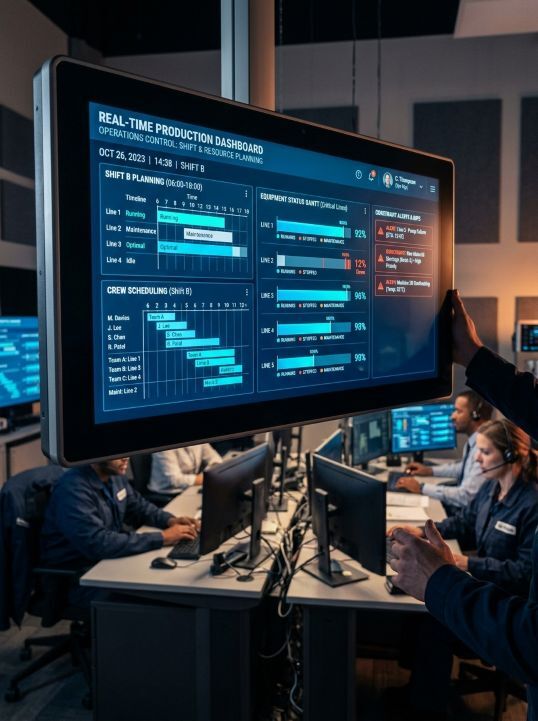
Close the loop between plan and reality with operator updates and real-time status
Operator task screens designed for station-based workflows
Start, pause, and complete actions with reason codes
Issue capture for blocking constraints, quality holds, and missing material
Real-time status propagation back to planning
Alerts for late or blocked work
Inputs
Published schedule, task instructions, and workstation or resource assignments.
Outputs
Live task status, delay reasons, execution timeline, and exception alerts.
KPIs Impacted
Schedule adherence, WIP aging, downtime impact, labor utilization, and rework drivers.
Master Data & Constraint Management (MDM)
Make constraints explicit, editable, and validated—so schedules stay correct as operations evolve
Part–operation sequences and standard times
Machine capability mapping + preferred resources
Operator skill/certification + shift availability
Tooling/fixture constraints (renewable resource limits)
Validation checks and discrepancy reporting

Inputs
ERP item master, routings/BOMs, HR/shift data, tooling lists (as available)
Outputs
Governed resource/route model, constraint completeness scores, discrepancy packs
KPIs Impacted
Schedule trust, planner rework hours, execution errors, rework
KPIs, Bottlenecks & Operational Insights
Turn schedule + execution data into action: bottlenecks, root causes, and KPI movement
KPI dashboards (delivery, throughput, WIP, adherence)
Bottleneck identification by workcenter/product family
Delay attribution (materials vs labor vs machine vs priority changes)
Trend reporting and operational cadence

Inputs
Schedule history, execution events, downtime reasons, work order outcomes
Outputs
KPI tiles + drilldowns, bottleneck reports, exception summaries
KPIs Impacted
Lead time, OTD, throughput, WIP, expedite reduction
Five steps to transform your manufacturing operations
Connect
Connect data from ERP/MES/spreadsheets and shop-floor signals
Model
Model constraints (routings, resources, skills, tooling, dependencies) and validate completeness
Optimize
Optimize schedules against objectives (OTD, throughput, cost tradeoffs) and publish plans
Execute
Execute + monitor with operator/machine updates and exception alerts
Learn
Learn + improve by updating cycle times/constraints from actual performance and iterating
Connect seamlessly with your existing systems while maintaining enterprise-grade security

ERP / MES / OT Systems
ERP Platforms
Microsoft Dynamics 365, SAP, NetSuite, Infor, and Epicor, integrated via APIs, data exports, or direct database connections.
MES Systems
Plex and other MES platforms supported through API-based integrations and reconciliation patterns.
OT Protocols
OPC UA, MTConnect, and edge gateways where machine-level signals are available.
Security & Compliance
Role-Based Access Control
Granular permissions by user role and department
Encryption
TLS in transit and encryption at rest for all data
Audit Logs
Complete tracking of schedule and master data changes
Flexible Deployment
Cloud, hybrid, or on-premises to align with IT policies

API & Connector Architecture
Connector-First Approach
Nexus ingests work orders, routings, inventory readiness, and execution updates through APIs or scheduled exports.
Validation Built-In
Discrepancy checks highlight missing operations, mismatched statuses, and relationship gaps before they break schedules.
Implementation
Structured deployment with clear milestones and fast time to value
Data Readiness + Trusted Schedule MVP
Core routings and constraints with the first schedule publish.
Execution Loop
Operator updates, exception alerts, and adherence tracking.
Expansion
Additional lines and sites, deeper constraint modeling, KPI cadence, and continuous improvement.
What You Need to Provide
Work order feed including IDs, due dates, quantities, and priorities
Routings and operations with standard times, or historical production data to learn them
Machine list with capabilities, and operator list with shifts and skills (as available)
Inventory and material readiness signals, even a simple state machine to start
Operational rules such as outsourcing steps, changeover logic, and dispatching preferences
Time to First Value
To a first trusted scheduling loop, assuming minimum viable data is available.Faster if routings and resources are clean; slower if master data relationships must be rebuilt.
Connect with Our Sales TeamProven results
Real impact from manufacturing operations using Nexus
Capacity increase
Observed capacity improvement in a discrete manufacturing context through constraint-aware scheduling and optimized resource allocation.
Cycle Time Reduction
Typical improvement range in total cycle time once constraints and execution loop are in place, with 10-15% improvement on fulfillment
Planner Efficiency
Fewer manual schedule rebuilds and faster reaction to disruptions through constraint-aware rescheduling and automated conflict resolution
See Nexus in Action
Walk through scheduling, execution, and KPI impact in 20 minutes—using yourreality (constraints), not a generic toy example